
FINAL EXAM!!

High school Workshops

Throughout the semester, our class had the opportunity to be leaders in high school workshops to ultimately encourage high school students to have fun with writing and also answer any questions they have about college. I felt that these workshops were beneficial to the students and myself even though we never were able to stay for too long. I noticed how little these high school students knew about college or even other bigger events that occur after high school like getting a job and having to do interviews. I was reminded of how I felt in high school and how clueless I was about what to expect. I liked that we were able to talk to the students in small groups and get to know them a little. This made it easier to ask them about their future plans for after high school and made it easier to talk to them about what they might be able to consider or what to expect in general. It was also enjoyable to do a fun assignment of creating our own stories as a group. However, one suggestion I would make for future workshops is to maybe spend less time on these activities and have breakout sessions in which the college students could simply get to know the high school students even more and learn about their interests. It might even be beneficial for the college students to create a list of suggestions for the high school students to consider doing after they graduate based on what we got to know about them.

What have I gained?

Can I just say first: wow. I actually have grown to genuinely enjoy writing because of this class. I think several factors come into play that have contributed to my changed perspective. First, it was comforting to be reminded to write freely and without stress. I know lots of professors say this, but this class was not based too harshly on grammar or structure or anything that was “right” or “wrong.” I think the biggest factor that made me get anxious about writing was that I never knew where to start and was always more worried about my grade, which distracted me and even prevented me from getting what I wanted to say down on paper out of fear of failing. On top of this, I admired how you would discuss the readings and made the class an open forum rather than a structured lecture. I feel that I actually gained some good experience from writing my rhetorical analysis and open letter essays. Specifically, when the open letter project was first announced I was nervous and did not have any idea how to go about it. However, I took it step by step and even discussed my weariness to you, mainly portraying how I struggle with more open-ended writing assignments since I am a science major and write a lot of lab reports. You reminded me to focus less on structure and just start writing down what I wanted to say in the open letter. Then, when it came to the rhetorical analysis assignment, I was not nearly as worried about how I would go about it. I think when stress and anxiety of writing an essay the “wrong” way was taken away, it was much easier to write what I wanted, and I even found that my writing turned out better than I thought anyway.

Most effective/entertaining assignment?

Out of all of the assignments, the most entertaining were probably the blog assignments, specifically the three audiences blog and the logical fallacy blog. I liked how these two pushed me to write in a different way than I normally would. They pushed me out of my comfort zone and forced me to do something less routine, which I enjoyed. I also like that we chose the topics for each because it made the assignments fun and personalized. As for the assignment that was most effective, I would have to say the open letter. This one was a challenge at first because I was so worried about organization and content, but then came to realize the letter is most effective when approached with a less structured approach, focusing more on the points I wanted to get across. I wrote my open letter to the Catholic Church, so doing the research portion of the assignment also made me realize how flawed the Church has been. I also found myself reading more articles on the topic that I did not necessarily need for my open letter, but I read just because I was engaged and wanted to know more.

Improved Perspective… (eventually improved writing)

Over the course of the semester, I do not quite know if my writing has technically improved; however, I can confidently say my mindset about writing has changed for the better. I now have realized writing is not as scary as it may seem. I think this new perspective will in turn improve my writing as time goes on.

Intrigued by Rhetoric

I remember learning about rhetoric in high school, but this course has expanded my knowledge on the importance of rhetoric. I did not realize how prevalent rhetoric is in our everyday lives and I also came to realize that rhetoric can be SO impactful. The way something is presented or said is far more important than what is actually being said. In fact, maybe I can utilize rhetoric when trying to convince my parents to buy me the new shoes I want or to get a puppy. Options are endless! Identifying rhetoric in essays, pictures, etc. can also be exciting and it can be fun to break down a specific piece in order to figure out the ways the creator tried to convey his/her point a certain way.

IT’S A PROCESS

They say “Writing is a process, not a product.” Can we just say… EVERYTHING is a process. Nothing comes easy and I have discovered, specifically pertaining to writing, to not rush anything. I found it beneficial to think of my ideas, maybe jot some things down, and then leave it alone. Then, I would come back to it and expand further. The more I set down my work and came back to it, the better my writing was and the more confident I was in what I was writing. It is important to focus on the process of writing because writing is best when it is developed over time and has a wide range of thought processes. What I mean by this is if I sat down and wrote my essay in one sitting and turned it in without really even reading over it, I would not only miss out on writing other thoughts in my head that might have popped up later in my mind and plus it probably would not sound good anyway despite the content because it was done in one sitting. I can use this idea of “writing is a process” in other classes by simply taking in information bits and pieces at a time, taking time to dwell on certain ideas so that way I can further elaborate my thoughts because more time would be put into understanding everything. Overall, I think everything takes time, shouldn’t be rushed, and should be looked at multiple times in order to develop a well-thought out piece whatever it may be.

Learning more about myself…

After taking this course, I have learned that I am actually not AS terrible of a writer as I thought. I also realized that free response style of writing is not as difficult as I initially thought when having the right mindset. Some assignments like the open letter shaped my own view as a writer because it forced me to take a completely different approach on writing than I usually would have done. I think the short blog assignments in general also collectively have contributed to shaping my perspective by coming to the realization that writing can be personalized and even feel freeing. These blog assignments allowed me to brainstorm different topic that I was interested in and made it so that I can be entertained with the assignment while also following the assignment guidelines. I even have learned how much I find both excitement and relaxation when I write, and in fact, I have started to journal here and there. It was truly just awesome to write what I wanted while also being pushed out of my comfort zone and discovering a new love for writing that I genuinely thought would never come :).
Observation Blog

Sitting in a coffee shop, I decide to take a break from studying and look around for a while. I notice this man, around the age of 40, across the room in one corner of the coffee shop sitting squished up as tightly against the wall as possible. He wore a nice suit and seemed very well-off as everything he was wearing or owned was high-fashion name brand material. His shoulders were hunched and his head hung low as he typed on his newest edition Mac laptop and drank his coffee. Occasionally he would briefly look up as if he was checking if anybody was watching him and then quickly put his head back down. You can see he permanent frown as if his face naturally rested that way. Maybe he is successful, but is he truly happy?

I was eating dinner at a restaurant and noticed a mom with four little kids at the table nearest to us. She had red hair and looked very young, especially for having four little kids. Crayons and kids coloring menus scattered the table. The lethargic look on her face seemed to linger, even when I would see her waiter try to crack jokes at the table. It seemed as though all her energy was sucked out of her. The kids became rowdy, yet she had no energy or desire to calm them down as she seemed so drained. Was she a lousy babysitter? Is she always stuck with the kids as her husband is at work? Maybe she recently went through a tough family situation or perhaps a divorce? Whatever the reason, the woman definitely needed a break.

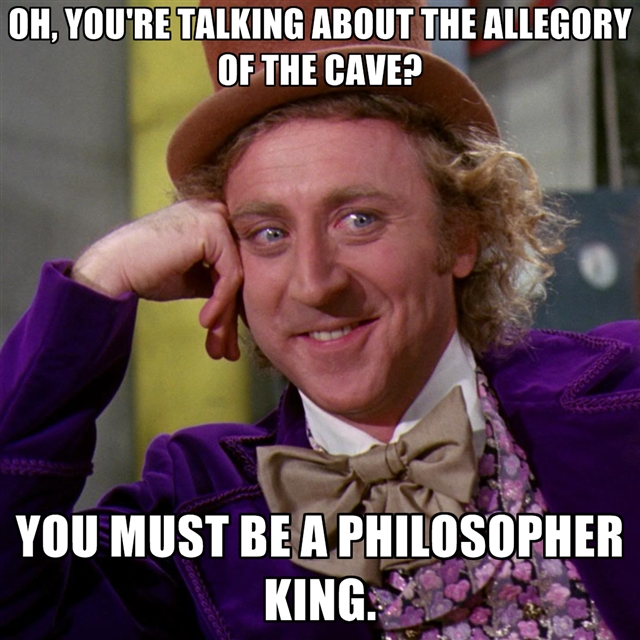
Rhetorical Analysis: Plato’s “Allegory of the Cave”

Plato’s “Allegory of the Cave” is a piece focusing on the human perception of life and reality. In today’s world, many people have a false image of reality. Plato’s piece is relevant and significant because it points out these distorted perspectives and emphasizes the importance of reorienting one’s self in order to recognize the truth about life, humanity, the world, etc. The main issue is that there are lots of ignorant people in this world who end up accepting everything they are given at face value. These people become “prisoners” to the illusions of the world and end up not even trying to dig deeper into the thoughts and ideas handed to them. This has become such an increasingly prevalent problem in our society today especially since there are so many sources like technology and media that has gained so much power over us, influencing our thoughts, feelings, actions, and perceptions. Every person is capable of learning more about reality and capable of furthering themselves on a path of intellectual growth; however, what it truly comes down to is one’s desire to do so.

Now, the audience addressed truly embodies almost every human being. This means there is not one specific group that is being reached out to, which is significant in the author’s argument because Plato had to create metaphors and symbols that could relate to a broad audience on many levels in order to appeal to as many people as he can.

In doing so, Plato used pathos, logos, and ethos to support his argument. In order to appeal to the audience’s emotions and elicit feelings that already reside in them, Plato made the people in the cave prisoners, which certainly creates a horrifying image in the reader’s mind already. On top of this, the prisoners actually represent all the human beings who are trapped, so the audience realizes they can relate to these prisoners and makes them feel anger that they are actually the ones trapped. The chains Plato specifies also stirs up anger and sadness in the reader because it creates vivid and brutal imagery in the reader’s mind. Additionally, Plato uses pathos by introducing the shadows which ultimately represent the perceptions of the prisoners. The shadows are only a portion of reality, but the prisoners believe in the shadows. This appeals to the emotions of the audience because the reader also becomes upset over how the prisoners are being manipulated by the shadows and creating a false perspective in the prisoners’ minds. The pathos then switches tones at the end when the emotions brought out are triumph and happiness as the prisoners found an escape and discovered new knowledge about true reality. On top of this, Plato utilizes logos to appeal to the reader through logic by basing his piece off the Theory of Forms, which is actually attributed to Plato himself. This theory suggests that the physical world is not as real or true as ideas that are absolute and timeless. In other words, the theory presents that the physical world is ever-changing and therefore can only be a source of opinion. This well-known philosophical theory gives some credibility behind Plato’s true message in “Allegory of the Cave,” which makes the readers even more enticed to read his work. Lastly, relating to the same idea, Plato uses ethos because his credibility as a philosopher automatically gives him some authority since he has been well-educated in philosophy and theory.

Plato uses rhetorical devices to effectively convey his argument that humans are often so blind to the knowledge they are freely given that they miss out on experiencing a new level of knowledge about reality. There are a lot of metaphors used in “Allegory of the Cave” that truly highlight his purpose by using symbols to relate one concept to the next. For example, the cave that the prisoners are trapped in represents how our knowledge is covered in darkness, just like a cave in real life. Similar to how being in a dark confined space prevents a person from seeing the real world, they are trapped in this misunderstanding of the world. The game described in Plato’s work directly correlates with the idea that there can be a master or leader when people are trapped in the empirical world. However, the point of bringing in this idea was to emphasize how it is a game and not actually real. That is, there is not one person who dominates over others in any sort of truth. In the philosophical world there is no hierarchy and people understand things on a new level. Another metaphor was the light, which represents one’s ability to comprehend the truth. Lastly, the escaped prisoner is a way of representing the philosopher. Philosophers desire to dig deeper into what the world has to offer. They seek what is beyond the cave in this case. Metaphors and symbols are clearly a large aspect contributing to Plato’s rhetorical techniques that ultimately lead to his purpose being successfully expressed.

In addition to both metaphors and symbolism, Plato also uses the rhetorical device of rhetorical questions to convey his message. The author incorporates rhetorical questions throughout the entire piece. In fact, almost every paragraph or section has at least one rhetorical question. Some back to back questions even elaborate his usage of this technique including:

“What do you think he would say, if someone told him that what he saw before was foolery, but now he saw more rightly, being a bit nearer reality and turned towards what was a little more real? What if he were shown each of the passing things, and compelled by questions to answer what each one was? Don’t you think he would be puzzled, and believe what he saw before was more true than what was shown to him?”

These questions have the purpose of subtly influencing the audience in thinking a certain way, directing their thought paths toward the author’s main goal of addressing the issue presented. As shown above, many of his rhetorical questions are quite descriptive, which demonstrates how Plato attempts to place certain key words or phrases in the readers head as well to draw attention to a specific topic or idea. Rhetorical questions can be so simple, but they truly make the writers ideas become more powerful in a way that is somewhat indirect.

This technique also adds to the writer’s voice, which is very calm and serious. The rhetorical questions contribute to his informative voice without being to authoritative or abrupt. This serious voice also aligns with the tone which is quite dark for the most part, but I think the sad and depressing tone created by the atmosphere Plato presents makes his argument most effective. The issue of humanity becoming so blind to reality is such a real, prevalent issue and cannot be downplayed by any lighter subject. 

Overall, I think Plato’s “Allegory of the Cave” makes use of rhetorical devices to effectively convey the message that people are stuck relying on their senses to make opinions and perceptions of the world or reality when instead real knowledge and truth derives from thinking beyond what the physical world provides in front of us. That is, through philosophical reasoning and digging into a sort of spiritual knowledge, one can discover what reality is outside from the material world. In order to get these points across, Plato combined different techniques of rhetoric to appeal to the audience in a way that would stir up interest so that his message could be taken to heart by as many readers as possible.

Logging off…

            Well, after “logging off” for two days I definitely gained a new perspective on everyday life. First of all, I have to say it was not as difficult as I thought and honestly was refreshing to simplify my life by taking away social media and TV/Netflix. To refrain from accidentally checking my social media by habit, I turned off my notifications for Instagram, Snapchat, Facebook, etc. I realized that it is actually not that hard to refrain from my phone when it is not lighting up like crazy from random notifications. As for the movies and TV shows, I do not watch much TV/Netflix already, so it was not very difficult to refrain from being tempted to watch anything.

            During these two days, I found myself walking around outside more, people-watching, and really appreciating what I was doing at any given moment. I felt like I had more time in general, simply because my phone was not distracting me. I did not realize how much homework I could get done! I always complain about how fast some days go by, but maybe it’s just because I don’t realize how much time I waste on my phone. Another thing I noticed in these two days was specifically when I ate meals. It may sound a little weird, but it was nice enjoying a meal without feeling the need to be on alert for my phone. Whether I simply fixed myself food at home or went out to eat with a friend, it was nice taking my time to eat and just have that time to think to myself or talk to whoever I was with, giving my full attention to whatever thoughts or people at the moment. What I enjoyed the most was when I was at a coffee shop or outside working on homework because I looked up more and just people-watched or looked at the nature around me. This made me feel so relaxed and it was nice just to unwind and let my mind go without distractions. I also realized my looking around more how interesting my surroundings can be and how fun it is to let my mind wander while observing everything around me.

            Typing this all out makes me realize how pathetic it is for being so amazed by what can happen when you don’t go on social media for two days. However, doing this definitely felt like a small, much-needed detox for myself. Life can get stressful and sometimes I find myself residing in electronics and social media to “de-stress,” but I strongly believe that technology is most often either the direct or indirect source of making our lives feel rushed and busy. Technology not only takes up our time by getting us wrapped up in viewing other people’s posts or scrolling through different apps, but it also can create a sense of FOMO (fear of missing out) which can cause extra stress or sadness as well. After my experience for these two days, I would highly recommend everyone should try to “log off” even if it’s just for small amounts intervals at a time. I am now more aware of the importance of refraining from distractions, and I will definitely be more mindful about how much I use my phone. 

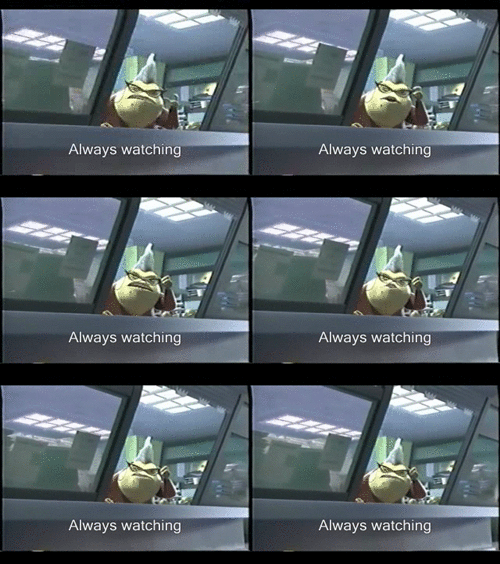
Someone is “Always Watching”

By: Brenna Darnbrough

In today’s world, Orwell’s vision of the telescreen has become a reality in our own homes whether we have accepted this or not. We can all agree there have been so many new devices and technologies that have risen in recent years. These technologies have been extremely helpful in many aspects, making our lives easier and more efficient in a variety of different ways. How convenient is it to say, “Hey Alexa, turn on every light in the house and turn up the music” and have everything happen for you without having to do those tasks yourself. However, have you ever thought of the mechanisms behind this? Maybe there is more to it that we do not know? This is just one example, but there are a multitude of devices in our homes (computers, TVs, phones, etc.) that have the capability to watch us, listen to us, and log our behavior. If I knew my phone, laptop, speakers, earphones, TV, or anything else in my house were watching and listening to me, I may be more conscious about what I do and say. This is not because I am doing anything illegal or bad, but why don’t you think about all the times you vent to people about problems in your life or things affecting you. There are lots of details we all say out loud to friends and family in our homes in person, through phone calls, or video chats. Would you want the government or some other party to know every detail of your life – where you are going, what is happening, and what is going on with you? I would not want others listening in on personal conversations all the time. To me, this definitely oversteps the level of privacy we all deserve as individual human beings. 

Technologies like this are keeping track of our life and every move, sometimes without us even realizing it. Sure, location tracking, cameras, and voice assistants are helpful and handy in carrying out every-day tasks and getting efficient updates all the time. But, the disadvantages to these technologies include the loss of our own privacy and individualism. We become like an open book. Personally, I would not want to give up all my privacy even for the safety of our country. There should not be a decision between privacy and safety. I understand monitoring certain things around us can ensure safety for communities, so I am not saying to get rid of every security camera. However, most of these forms of monitoring are purely for conveniences just like the examples I described earlier in our homes and then turn out of control by exceeding the level of monitoring we think these devices are doing. Technology has grown so rapidly that it has already crossed the line of privacy that we all deserve and really it can only get worse, making our lives even less private then they are now. 

Open Letter: Catholic Church Scandals

Dear Catholic Priests,

            Please let me begin by stating that I am writing you with all possible sincerity, on an issue important for myself and all Christians. Personally, I have a lot of respect for the priests and organization of the Catholic Church and the generally positive impact the Church as provided for Christianity as a whole, no matter the denomination. My heartfelt concern and reason for writing regards the continually recurring discovery of child sex abuse scandals occurring even up to this day, and ongoing since the early 1950s or earlier (Kelly 2018). I am sure this is no news to anyone at the moment. However, I am struggling to understand how the Catholic Church is moving ahead in light of this widespread issue, and I would like to ask how you are working to make things better.

            Being a non-denominational Christian, I have always looked up to the Catholic religion as a foundational part of Christianity, although I am not completely sure of the Church’s stance on non-denominational sects. I have many friends and relatives who are active Catholics, and I would even consider attending a Catholic Church sometime to learn more. However, the scandalous news associated with Catholicism seems to be strong enough reason for me to not only avoid attending your services, but to actually oppose your ideals as a whole. Please explain to me why I should try out a church that has been so corrupt over the course of history and has been actively covering up child sex abuse scandals without accepting any ramifications.

Aside from this affecting my own personal view of the Catholic Church, the exposure of these terrible acts creates a bad reputation for Christians as a whole, regardless of the denomination. Higher level Church leadership shoulders much of the blame, but really there is a significant issue facing the Catholic priests in communities throughout the world. You are leaders. You are the representatives that people look up to in times of difficulty. You are the face of Christ on this earth. How do you think people can trust in you, or the Church for that matter, at this point? You live to turn people towards God and direct them in a good direction, yet your actions have shown otherwise.

There is hope though. It is undeniable that all people sin and make mistakes, and I believe that people’s mistakes should not define them if they are willing to acknowledge them, ask forgiveness and make changes. You, as individuals, have the chance to overcome what you have done or seen.

The original abuses are deplorable, but it is also shocking how much the Catholic Church has done to cover up these sexual abuse scandals. For example, it was revealed that in 2002 a Catholic Church in Boston paid ten million dollars to over one hundred and thirty victims who had been sexually abused by a single priest (Kelly 2018). On top of this, the following year another eighty-five million dollars was paid to victims’ parents who were filing lawsuits over the abuse (Kelly 2018). By the amount of money put into covering up the priests’ dirty work, it is evident the Catholic Church will do anything to save their reputation even though the Catholic religion embraces confessing one’s sins to others (Osborne 2011). How many better causes could this money have gone to throughout the world, and how many life tragedies could have been avoided?

These findings are just a small portion of evidence demonstrating there are not just one or two bad actors. Rather, it seems to be pervasive throughout the organization as a whole according to what these news stories have indicated. In fact, small gestures have been found that denote the widespread secretory manners of Catholic priests including findings that claimed some victims were gifted gold cross necklaces to indicate which boys had been “groomed for abuse,” (Kelly 2018). This nonchalant way of communicating between priests only highlights the connectivity of the network Catholic priests have secretly created within the church.

Now, I understand there are a lot of lifestyle teachings and rules that the Catholic Church imposes on their community of both followers and leaders. One of these “rules” include that priests remain celibate. The Catholic Church does not technically force priests to not marry in all cases (some do though). However, the majority of your group often chooses to take this vow regardless in order to remain faithful to your calling and ministry as a significant religious figure in society (Osborne 2011). Maybe it truly is the priest’s choice in some cases; however, it is also very reasonable to notice that this lifestyle suggestion seems more like an unspoken demand if it is not already heavily enforced. Could this be a reason that you, priests of the Catholic Church, have been caught falling into these terrible acts? Is the pressure to accept this way of living by the Church’s standards too overbearing? Maybe it is the only way to let out your desires in a way that is hidden from society so that your reputation as an unmarried man remains intact? I can see this side of the argument to a certain extent. However, this is certainly NO excuse to sexually abuse children. When it comes down to it, there will truly never be a reasonable explanation for all the corruption that has been occurring in the Catholic Church. 

What is even more saddening is how state and federal laws come into play with these situations. Priests are not required by law to report such crimes to the police that they are clearly aware of (Reese 2019). This just gives them another reason to feel less guilty about what has happened. In addition, when people successfully sue a priest, the priest never actually suffers from the resulting payments. This is simply because the money belongs to the specific Church district that the accused priest administers, which is a nonprofit charitable enterprise that has no true owners (Reese 2019). Then, even if the priest happens to be reprimanded by the Church, he will simply resign and is not required to state the reasons for the resignation (Reese 2019). This clearly does not address the issue whatsoever, and change needs to happen by creating more awareness and taking real action to reevaluate the leaders of the Catholic Church.

An anonymous open letter was written by a sexual abuse survivor who was molested as a young teenager by a priest and was brave enough to write down his story. The first detail he addresses is that this particular priest was a man which his entire family and himself had trusted for many years. Looking back, the victim has pieced together exactly how the priest “groomed him for the big night” (“Sexual Abuse Survivor Story”). The priest was a man who knew the victim on a personal level and there would be many times the two of the individuals were alone together. It was normal for the priest to take the young boy to dinner, as his parents were completely accepting of this. However, he slowly started ordering alcohol for the young boy and eventually introducing him to illegal drugs as well. The next step was the priest showing the innocent child pornography. “The night of the abuse I was drunk and high and very vulnerable and accessible to him. I was just a kid,” (“Sexual Abuse Survivor Story”). The ramifications after the night of the assault took a huge toll on this young boy’s life. He developed signs of depression and “I even started having thoughts of suicide,” (“Sexual Abuse Survivor Story”). The victim went to counseling, but he did not ever spill his secret since he did not even think that was the root of his problems. He even states, “I began to abuse alcohol. I am an alcoholic and always will be,” (“Sexual Abuse Survivor Story”). He was lost and confused and as a result became angry and aggressive. One excerpt from the boy’s open letter includes: 

“There is not enough money that can take away the pain, shame, thoughts, and guilt that I have endured. Young victims are too ashamed to come forward and too young to understand the damage that was done until decades go by. […] I have only told a handful of people. […] However, some don’t understand the complexities or the consequences that abuse victims endure through their life due to the abuse,” (“Sexual Abuse Survivor Story”).

            This is just one example of a personal account from someone who was a victim of sexual abuse by a priest. Imagine the others and the ranging severities of each case. This is not a light issue as this story clearly demonstrates how much it impacts the children in the moment as well as their entire life after. It is evident that changes need to be put into motion, starting by making sure the any priests who are guilty are held responsible for their terrible actions. There certainly is a great amount of difficulty in obtaining solid data on sexual abuse, but by creating awareness and digging deep, communities all over have the ability to unite together and protect these innocent children. We can rise up and change the way the Catholic Church operates, but it will take the efforts of us all.

Sincerely,

Brenna Darnbrough

Works Cited

Kelly, Laura. “Catholic Officials, Vatican Systematically Covered up Priest Sex Abuse, Report Reveals.” The Washington Times, 14 Aug. 2018.

Osborne, Graham. “Why Can’t Roman Catholic Priests Marry?” Catholic Education Resource Center. The B.C. Catholic. 2011. http://www.catholiceducation.org/en/controversy/protestant-objections/why-can-t-roman-catholic-priests-marry.html.

Reese, Thomas. “Taking Stock of the Clergy Sexual Abuse Crisis: Holding Bishops Accountable.” National Catholic Reporter: The Independent News Source, 29 Mar. 2019.

“Sexual Abuse Survivor Story | Child Molestation Victim Letter.” Klest Injury Law Firm. www.chicagotriallaw.com/Sexual-Abuse-and-Assault/Open-Letter-to-a-Sexual-Abuse-Victim.shtml.

Logical Fallacy: Fast Food is GOOD

Fast food is by far the best food out there. In today’s world, people thrive off of anything instantaneous. Our culture has encouraged people to think that things that come faster to us are better. And this is true! Picture this, you are rushing from school to work and have no time to go home and make a gourmet meal. What do you do? You go through the nearest drive through! How efficient is it to order your food and then by the time your car pulls up to the next window, your meal is already prepared? Let me say, it is the most efficient thing out there.

Some may argue that the quicker the food is made, the less the quality of the products. I beg to differ. Fast food simply makes fresh food in a timely matter. Have you ever been to In-n-out? Odds are you have, and you cannot tell me that there aren’t windows surrounding the entire restaurant revealing the chefs cooking each patty to the customers liking. Sure, the patties may be frozen, but that does not mean they are not fresh. The workers go through an extensive training process in order to handle your food with care, no doubt. Fast food employees are there to serve you; they get excited to provide clean delicious food for you.

Fast food is also a cheap way to get the same food every time. People want consistency and reliability in our world today. Why live life in question? Fast food chains ensure this sense of dependability at such a low cost! Don’t you hate when restaurants mess up your order? You’ll never have to worry about this at fast food chains. Fast food will be prepared the same way every time; in fact, sometimes it will look even identical! Don’t listen to those that say fast food isn’t good. Fast, fresh, easy, and delicious are ALL words that describe fast food.

Streaming vs. Theatre

Netflix and chill? More like Netflix and kill (the theatres!). Streaming movies may seem like one of the most innovative advancements that have been brought about over the years. However, this somewhat recent phenomenon is actually destroying the idea of watching movies in theatres, and stripping people of one of the most important aspects of movie watching. 

I will never forget the day that my dad took me to see the last Harry Potter movie. I grew up in love with the series — I’d stay up all night reading the latest book, and steal bathroom breaks in the middle of my classes to finish what I didn’t read the night before. When I first saw the trailer for the last movie, I was over the moon excited. So one morning, when my dad said he wanted to see it with me in theatres, I couldn’t get it out of my head. All I could think about was watching my favorite characters, friends I loved and looked up to, on the big screen. Needless to say, my expectations were high. 

      Still, nothing could have prepared me for the incredible story I watched unfold on screen that night. Everything was perfect; the spells, the flying, the mythical creatures— it was all better than I could have hoped for. It felt as if the theatre had fallen away around me, and I was in Hogwarts with Harry, Ron and Hermione, fending off the Death Eater invasion and trying to figure out Voldemort’s final weakness. 

      I have never, nor will I ever, experience the same level of magic and awe using a streaming service. Sure, it may be far easier to dial up whatever movie you want and throw it up on your Macbook screen, but as you do this, you trade something very special away: the experience of going to the movies. Never in a million years will I forget how I felt going with my dad to see the last Harry Potter. The anticipation of the drive, buying the tickets and popcorn, shuffling into the best seats we could find, and hearing an entire room of hushed, excited whispers— these are all moments just as invaluable as the movie itself. Streaming trades this all away for the widely accepted fallacy that movies are best experienced from the comfort of your own couch. The worst part is, as more people accept this belief to be true and streaming becomes increasingly popular, movie theatres lose valuable customers. Soon, all movies will be sent straight to Netflix, just like Roma was, and soon, “going to the movies” will be just as ancient as listening to sports games on the radio. 

Literacy Narrative

By: Brenna Darnbrough

No wonder students have no desire to read and write…

            It all started back in middle school when book reports and summer readings became a regular task for students, and only got worse when high school came around. I was naturally a slow reader, so I always felt behind in my reading assignments and was frequently worried I would never be able to catch up. It did not help that I had extracurriculars and many other commitments being an involved high school student. Consequently, this lack of time and motivation would often result in me searching an online summary of the book, so I could understand what I needed to know for the quizzes and tests. Doing this obviously meant I was not able to grasp the beauty or depth of a given reading assignment, only uncovering the surface of the material inside that was purely a mystery. Therefore, reading felt like a chore and I did not have any desire to read on my own time since I let my busy schedule get the best of me, ultimately creating a negative mindset in my head about my attitude towards books.

            Despite this poor experience, this most recent Interterm changed my perspective about reading. I enrolled in a class called Health and Spirituality to satisfy and elective for my major. This class did not have tests or quizzes of any form. Instead, different speakers would talk to us about a variety of topics pertaining to both health and spirituality. On the side, we had a few books that we were assigned to read. When the professor first mentioned this, I immediately pictured me having to sit down and forcing myself to read, most likely ending up on Shmoop or Sparknotes. Only pure dread came to mind since I had negative experiences with reading in the past. However, I came to realize that the professor was not going to quiz or test us on any of the material and instead simply asked for a typed journal (with no particular length!) to summarize the book, but more importantly express our thoughts and feelings as we read the pieces. Since I knew I was not going to be graded on my feelings, I decided to actually read the books without worrying about any requirements. It was easier to get myself to actually read the books since Interterm is quite relaxed, given that I did not have an entire schedule of classes all day long. I am glad I gave reading a true chance because I found it was refreshing to read the books and write down my thoughts with no structure whatsoever. I found that I actually had a difficult time setting down the books once I started reading them because instead of focusing on the specific information I may have needed to pass a class, I just read the books with no stress and no presumption in mind. This experience allowed me to then realize that I wanted to make it a point to set aside time for leisure reading even as my schedule got busier because I found it so relaxing. It allowed me to remove myself from my phone and all the distractions in my everyday life, ultimately slowing down and focusing on one thing. Although I may not want to admit I just recently started to enjoy reading and that it took me this long to find that joy in reading, I am grateful that this professor set up her class in a way that let students wind down and find the delight in reading and learning in general.

            As for writing, growing up with teachers handing back papers with excessive red markups truly discouraged me form the start. I felt overwhelmed and believed I was always one step behind everyone else. All the bright red markings on my paper communicated to me that I had too much to work on, so I figured I would never be able to fix all of my mistakes. This made me lack the courage to try harder in order to improve my writing skills. However, thankfully my dad happens to be an insanely smart engineer and technical writer. As I got older, my papers obviously became more important, and I began to run most of my work through my dad as a personal peer editor. I liked the way he broke things down for me. Even though I am sure he would have wanted to point out every mistake, he never failed to provide feedback that was merely the most basic advice and did not try to critique every part of my papers. Gradually, he would critique my work more harshly as I developed my writing skills more. Personally, this helped me because I was not overwhelmed with a bunch of corrections on every portion of the paper that I had no idea what to do with. Instead, I was able to nail the basic components that he advised me to alter. Without even fully realizing it in the moment, this made writing less stressful. Fixing one thing at a time allowed me to excel through many small steps rather than being thrown a bunch of corrections at once and being expected to change my entire way of writing. On top of this, my dad taught me how to have fun with writing. He always encouraged me to be creative even if the paper was on a serious topic. He encouraged me to find joys in writing by making it my own instead of going through a checklist, which was often recommended by most of my teachers growing up. 

            Often quizzes and tests are demanded in order to motivate students to read, but I found that once theses assessments were taken away, I became even more inspired to read. This has a lot to do with the fact that my anxiety significantly reduced, and I developed genuine interest in reading. Similarly, the pressure of grades can make writing feel like a burden on students as I recall always being discouraged by all the mistakes the teacher made known to me. I think my dad’s simplified encouraging methods of critique blurred my negative perception of writing that teachers bestowed on me and allowed me to excel in writing, while also finding some pleasure in writing as well. Creating an environment in which frays from demands and emphasizes the true beauty in reading and writing has the power to stimulate true drive in students to expand their literacy because, although it took me a while, I finally realized reading and writing are not as terrifying as most students think.

3 Audiences – Shoplifting

episode 11 shoplifting GIF

By: Brenna Darnbrough

** DISCLAIMER: this situation is NOT based on an actual situation/decision I have made**

Dear Friend,

I have a confession to make. So, you know how I have been wanting Lululemon leggings for so long? I don’t make enough money to purchase a pair, which you obviously know. However, naturally, I came to the decision that I was going to own a pair. I rolled up to Fashion Island in Newport and looked at the price tags and did not even have that much money in my checking account, except I couldn’t stand not owning a pair of Lululemon leggings anymore. Literally everyone has at LEAST two different pairs, I swear. I did something I probably shouldn’t have… it was a Monday and only a couple employees were there, so I took my chances. I grabbed the cute new gray pair they came out with recently and stuffed it in my purse while I was in the dressing room trying several other pairs on, making it less noticeable that one was missing. I didn’t feel a sensor on them, so I figured my plan was going to work. I walked out telling them I didn’t find anything but before I knew it, I was getting arrested for shoplifting. I felt like I had no other choice! My parents don’t help me out financially so what else is am I supposed to do?! My paycheck can only cover food and rent, and lately they have been cutting me short on hours as well. On top of that, I have to pay to go out with our friends and do fun things because I can’t just be unsocial, you know?! Us college students need to fit in. I know you own about four different pairs, but don’t you see where I’m coming from? Who wants to be that one person that doesn’t own a pair of Lululemon leggings. NOBODY. Wouldn’t you do the same? I just can’t believe I got caught, it’s not fair!!

Dear Mom and Dad,

How are you doing? I miss you! I wanted to give you a quick update on a few things in my life recently. I have been getting outstanding grades this semester so far. Remember that physiology exam I was worried about the other week? I ended up getting an A and the average was a C! I can definitely see all my hard work paying off. Thank you for encouraging me throughout the process. You know how much you mean to me and how thankful I am for you two. You guys are so loving and caring no matter what. I know I can count on both of you to be there when I need support in any circumstance, even at my lowest points in life. Now, there is no easy way to say this, but although I have been doing SO good in school, I ran into a little bit of trouble elsewhere. My current job has been cutting me short on shifts, making it difficult to pay for rent, food, and a few other things on the side of course. I know you guys do your best to provide for me even though money is tight, and I totally think that being independent is allowing me to grow. However, I just need to be completely honest with you guys, because I know you deserve that. Due to my lack of money, I have to confess that I got arrested for shoplifting. Mom and Dad, you have to recognize that this is totally out of my character. I am so so so sorry. Please try to see my side of it. I am young and make mistakes. College is not as easy as it looks. There is so much pressure to look a certain way and own the best brands of clothes, shoes, etc. Everyone around me wears Lululemon leggings and I swear people started to notice I was one of the few who didn’t own a pair. It was affecting me emotionally, I just wanted to fit in. PLEASE understand that if I could go back in time, I would take back everything I did. I would have talked to you guys beforehand to help me through these feelings based on all the peer pressure around me. I hope you could help me get out of this mess and forgive me for this poor decision. Thank you again for loving me unconditionally. 

Dear Coach,

Great win last week, right?! I can’t believe I made that legendary goal. Did you know it’s actually on Youtube now? All of your advice and tips are always greatly appreciated. I truly feel that I have grown so much as a soccer player and my full potential is finally beginning to become noticeable, all because of you. After knowing me personally for so many years, you know that I am a good person and always try to do the right thing. I would never intentionally do something bad knowing the consequences. I have to let you know, however, that I made a poor decision. I was caught shoplifting and ended up getting arrested. I regret every bit of my decision and I am so sorry to let you down. As you know, I have been struggling financially and I came to a low point. I feel like I work so hard in school and sports, yet I don’t have the money to do what “normal” college students do or have what they have. It’s difficult being young and pressured by the world around me. Please understand that my intentions were not for things to happen like this; I would hate to lose my starting position on our team, especially after realizing how far I’ve come right? I am so sorry again, I hope you can have sympathy and help me through this hard time.